AI Makes Creative Work Faster. It Also Makeå
How we’re using AI to ask better questions, clarify creative direction, and decide what deserves a place in the work.
Written by: Meghan Sellers, Creative Director
Ten campaign concepts can give a marketing team more to review without giving them a clearer idea of what to approve.
One leader wants the company to look more established. Another wants something bold enough to stand out. Marketing is trying to reconcile both while keeping the launch on schedule.
AI can make another round of options easier to produce. But if those options are being judged against different expectations, the team still has the same decision to make.
That’s the tension we’re working through as we bring AI into our creative process at Brew. We’re using it to build discovery tools and explore visual ideas. Those applications have value. But they also make us more deliberate about the decisions that guide the work.
For marketing leaders, the opportunity goes beyond faster production. It’s using that speed to make expectations clearer before more time and budget go into execution.
Two parts of our own workflow show what that can look like.
We used AI to make website discovery more concrete
A service list tells us what a company does. It doesn’t necessarily tell us why a customer should choose it.
That distinction became useful during a recent website discovery session. We were developing a shared page structure for a client with several service areas. The goal was to help visitors understand each capability while presenting the business as one connected company.
Using Claude, we built an interactive discovery wireframe that placed our questions beside the sections they would inform. A service overview sat alongside questions about what the team did and why customers chose them. A proposed project section included prompts about what those examples needed to prove.
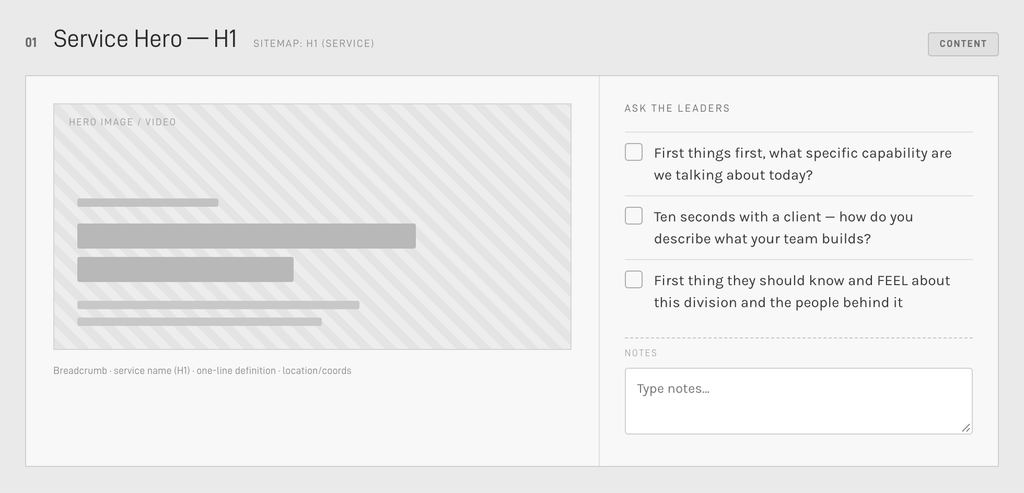
The wireframe also included checkboxes and space for notes, so we could work through the questions together.
That structure helped us move from collecting information to discussing what deserved a place on the page.
Screenshot labels and questions have been anonymized for publication.
A list of capabilities wasn’t enough to explain the value
When we asked which individual capability stood out to customers, the answer challenged the question. Other providers could offer similar services. The more meaningful distinction was how the team coordinated complex work and delivered it reliably.
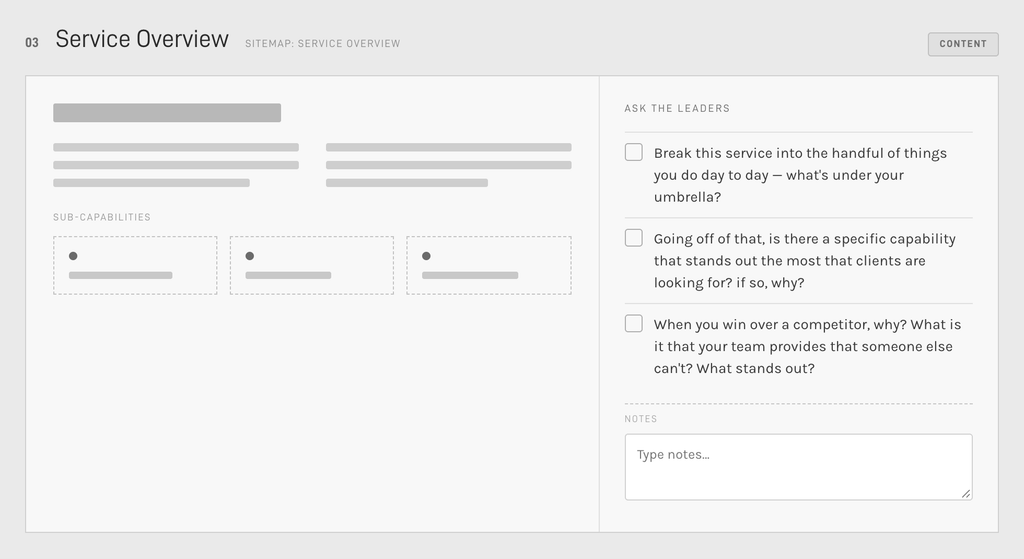
That gave us a clearer direction for the content. A list of services could establish what the team offered, but the supporting project stories needed to explain how they managed the work.
We followed up by asking what would impress a prospective customer about a project: its size, its location, or its outcome? The discussion returned to coordination—managing multiple activities and keeping work on schedule.
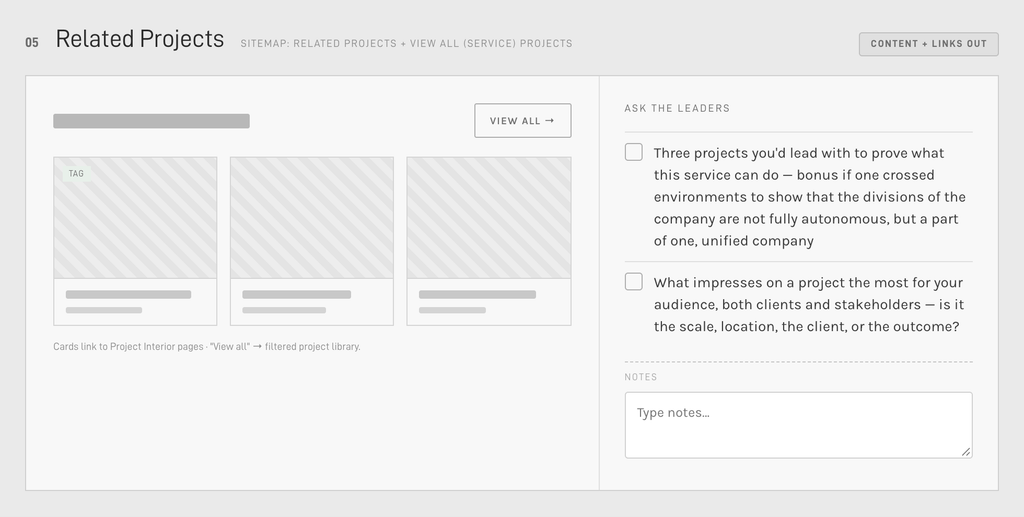
That gave us something specific to look for when selecting and developing project examples. We needed stories that demonstrated the team’s approach, rather than relying on impressive images to communicate its value.
An existing service didn’t need the same prominence
The wireframe also flagged a service that had received significant attention on the existing website.
We asked whether it was a reason customers contacted the company or work that typically came as part of a larger engagement.
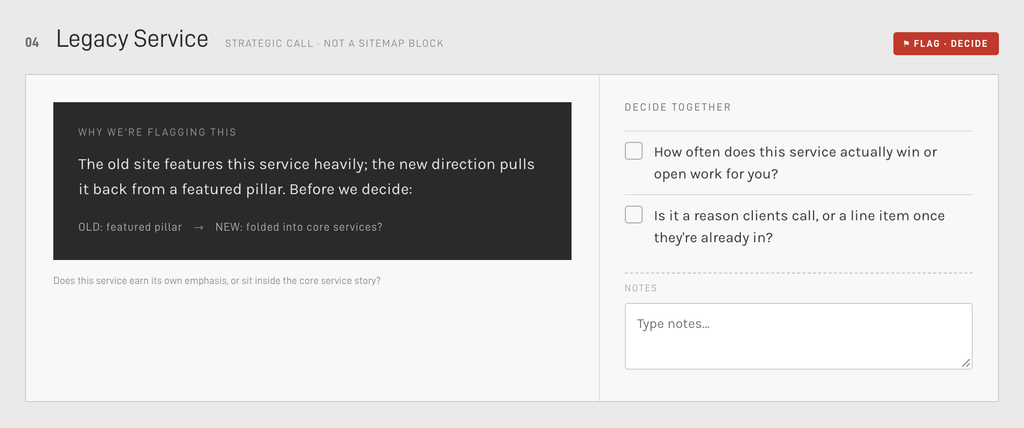
The discussion confirmed that it didn’t need its own emphasis. The company could still perform the work, but it wasn’t a service the team needed to actively promote.
That was a useful distinction to settle before writing and designing around it. Carrying everything forward from an existing site can give yesterday’s priorities the same weight as today’s.
AI helped us build the format for these conversations. Our questions, the client’s knowledge, and the follow-up discussion established the direction.
For a marketing leader, that’s a practical use of faster production: creating something concrete enough to examine assumptions before they become finished pages.
We use Leonardo and Photoshop to develop an idea beyond the first image
We’re also using AI within visual production.
Our workflow includes generating visual material in Leonardo AI, then bringing it into Photoshop to reshape, refine, and combine with other elements.
That gives us another way to explore an idea. It also creates a clear point where we have to evaluate what the generated material contributes to the finished work.
An image can be interesting on its own and still need substantial changes to support a campaign. We have to consider the message, the composition, the brand’s visual style, and the other pieces it will appear alongside.
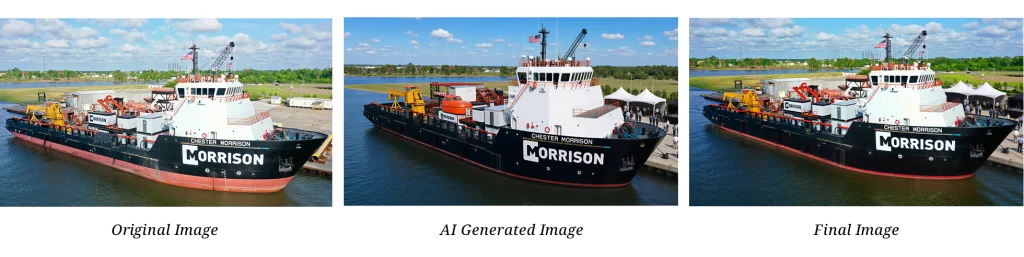
In this example, we started with an existing photograph and used Leonardo AI to explore a revised version. We then brought both into Photoshop, blending selected generated elements with the original photography to create the final image. The generated version gave us material to work with, but we still had to decide which changes improved the image and which original details needed to remain. Those choices shaped the finished composition—and gave us specific reasons for the direction we took.
For the person approving the work, those reasons matter. They create a basis for discussing whether the creative does its job.
Without that basis, a review can become a contest between personal preferences. One person likes the initial image. Another prefers the refinement. A third asks for more options.
More generation is easy to request. Agreement on what the image needs to accomplish takes a different kind of work.
Repeated revisions can point to a decision the team hasn’t made
Both workflows bring us back to the same question: what has the team agreed the work needs to do?
When that answer is unclear, faster production can make the consequences more visible.
Imagine a website that promises highly personal service, a campaign that emphasizes convenience and speed, and a sales presentation that leads with price. Each piece might look professional, yet together they give customers different reasons to choose the company.
The marketing director then has to reconcile those differences, often one deliverable at a time.
That takes review time, revision time, and attention that could have gone toward improving the work. If the underlying expectations stay unresolved, the next project can reopen the same debate.
A useful signal is feedback that keeps changing the assignment. “Make the headline stronger” becomes “we should lead with a different service.” “Try a different image” becomes “we want to attract a different customer.”
Those may be worthwhile changes. But they need to be recognized as decisions about direction so the team can address them together.
Give the next creative review a shared starting point
Before the next AI-assisted project, we’d suggest agreeing on three things.
1. Who is this piece for, and what should they understand?
Be specific enough to guide a choice. “Potential customers” leaves more room for interpretation than identifying the customer’s situation and the question the piece needs to answer.
2. What will we evaluate the work against?
Write down the intended message, the relevant brand characteristics, and the action the piece should support. Use those criteria during review so feedback has a shared reference point.
3. Which decisions are still open, and who will resolve them?
AI can help explore possibilities. Everyone involved should know whether they’re reviewing an early experiment or approving work against an established direction. Otherwise, a polished concept can move ahead of an unresolved conversation.
We’re excited about having more ways to explore and make things. Our experience with these tools is also sharpening our attention to what happens before an option becomes a finished piece.
If creative keeps coming back for another round, look at what the feedback is asking the team to decide. The next useful step may be a clearer agreement about the audience, the message, or the brand.
That agreement gives faster production somewhere useful to go.