The Three Words Your Customers Use That You Have Never Put on Your Website
Strong brand messaging is not created only in strategy sessions; it can also be found in the words customers already use. A May 2022 Journal of Interactive Marketing report, The Language of Brands in Social Media: Using Topic Modeling on Social Media Conversations to Drive Brand Strategy, analyzed more than 134,000 messages referencing 193 brands and used the language in those tweets to map how those companies existed in people’s minds. The most surprising thing they found, in my opinion, was a .81 brand-topic correlation between Gatorade and Smirnoff vodka. For context, the same analysis found a .92 correlation between Gatorade and Powerade. Looks like Red Bull isn’t the only thing that gives you wings.
But while interesting, that’s not the point. The point is the words people use around a company do not merely tell you whether they like or dislike it. They can tell you the parking spot the company occupies in the consumer’s mind, which competitors are parked nearby, what usage occasions people associate with your brand, and what risks or opportunities may be emerging in the near future.
In other words, unstructured consumer language reveals opportunities to improve brand messaging.
How Customer Reviews Reveal Brand Messaging Opportunities
Customer reviews have long been mined by brands looking for problems. Customers complain about something. Researchers or operations people record where defined patterns appear and, hopefully, fix them. Those that don’t, do so at their own peril. That’s not nearly as interesting as flipping the review script. Every company knows its pain points, even the ones that don’t fix them. Voice of customer research was built to surface those problems. But what happens when you flip it?
What would happen if you analyzed tens of thousands of reviews looking for any consistent positive linguistic pattern? There are words and phrases your customers use to praise you that have never appeared on your website or in any deck your marketing team has ever produced. Not because someone rejected them. Because no one took the time to notice them.
What Brew Found in 73,000 Hotel Reviews
We spent time looking at this pattern inside Hyatt’s portfolio, scanning TripAdvisor reviews across eight U.S. properties: Park Hyatt Chicago, Grand Hyatt Washington DC, Hyatt Regency New Orleans, Hyatt Regency Grand Cypress in Orlando, Hyatt Regency Waikiki, Hyatt Regency Chicago, Hyatt Regency Atlanta, and Manchester Grand Hyatt San Diego. Roughly 73,000 reviews in total.
We were looking for something specific: language that customers use consistently, across properties, that Hyatt itself does not use in its own marketing. It didn’t take long to find. That disconnect between customer language and company language can reveal overlooked brand messaging opportunities.
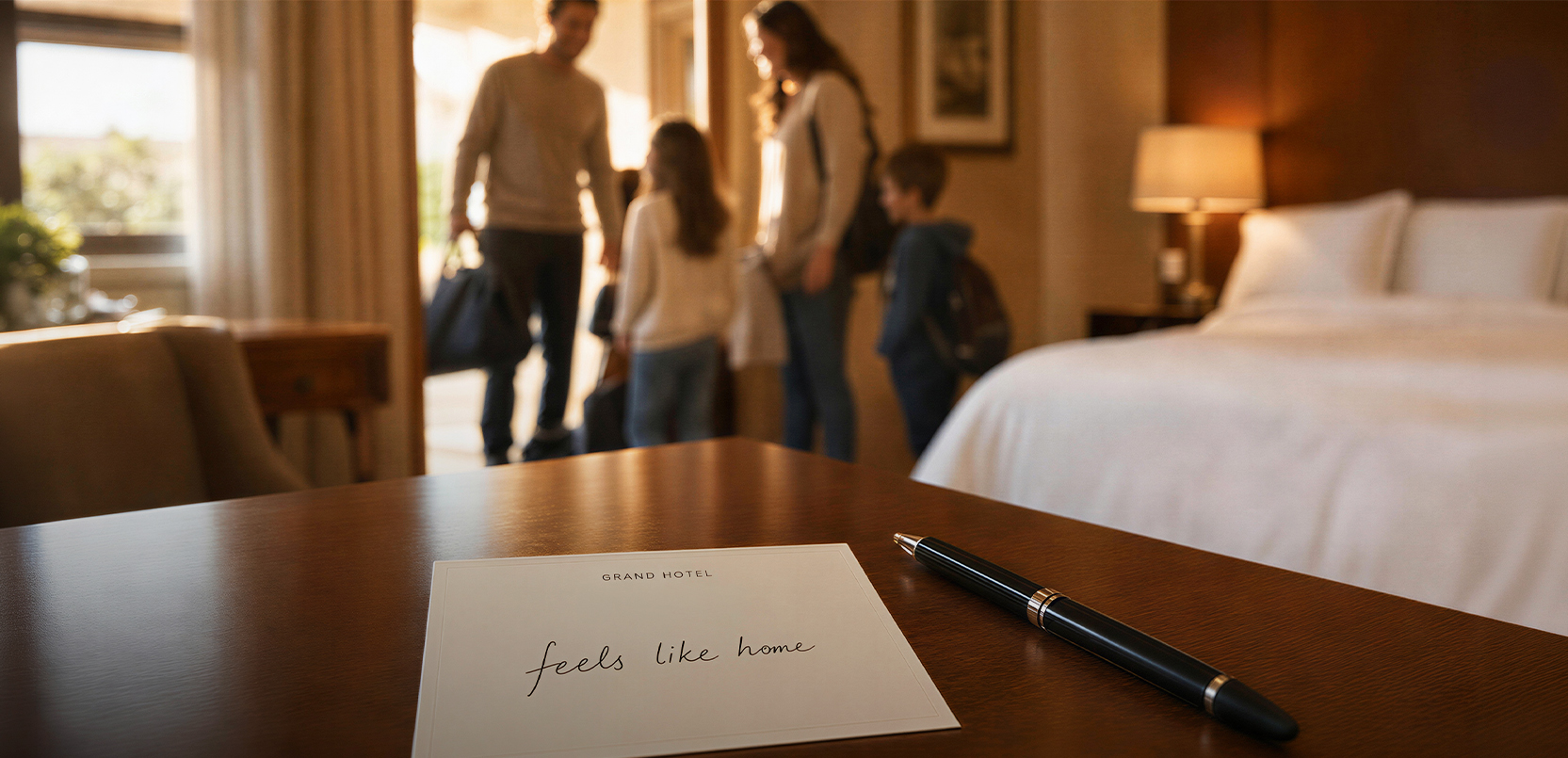
Guests kept saying “home.”
| Property | Feels Like Home | Home Away From Home | Felt at Home | Feels at Home | Unique Reviews | % of All Reviews |
| Park Hyatt Chicago | 16 | 29 | 16 | 29 | 66 | 2.48% |
| Grand Hyatt Washington | 20 | 40 | 29 | 29 | 78 | 0.94% |
| Hyatt Regency Grand Cypress Resort | 46 | 76 | 49 | 64 | 151 | 1.46% |
| Hyatt Regency New Orleans | 17 | 30 | 23 | 25 | 64 | 0.82% |
| TOTAL | 99 | 175 | 117 | 147 | 359 | 1.23% |
To save a few thousand AI tokens, we chose four properties for a more stringent verification step. Once the AI tool had completed its analysis, a Brew staffer verified the accuracy of the results. 359 instances across 29,070 reviews, or 1.23% of all reviews from this tighter data set.
“Felt like home.” “Feels like home.” “Home away from home.” “Felt at home.” The phrases showed up across every property we looked at, from a $600-a-night Park Hyatt suite in Chicago to a Hyatt Regency conference attendee in New Orleans. Price didn’t matter. Trip type didn’t matter. Business travelers said it, and so did families on vacation.
On just the New Orleans property alone, 7,810 reviews. We found over 130 matches across six variations of the phrase. “Home away from home” was the most common. “Felt at home” was second. Some guests used it in their review titles. One wrote “Feels Like Home” as a headline. Another titled a five-star review simply: “Always feels like home, won’t stay anywhere else.”
This wasn’t a fluke at a single property. At the Park Hyatt Chicago, a guest in May 2026 wrote: “The suite felt like an oasis, true getaway even though I was visiting on business. The rooms feel like home.” At the Grand Hyatt Washington, a guest wrote: “Even though the hotel is huge, it felt like home. Every staff member treated me as if I was a guest in their home.” At the Hyatt Regency Grand Cypress in Orlando, a guest titled their review simply: “Grand Cypress, my second home.”
When the same emotional word shows up across four different properties in four cities, thousands of miles apart, from guests who will never meet each other, that’s not a coincidence. That’s a signal worthy of additional investigation.
But What Does Hyatt Say About Its Properties?
To confirm we’d discovered a real-world versus marketing-driven pattern, we then went to Hyatt’s own property websites for those same hotels. We reviewed homepages, marketing copy, and the brand language visitors encountered as they moved through the websites.
We searched for any variation of ‘home,’ or the broader concepts of belonging and settling in. Across all four property websites we analyzed in detail (Chicago, Orlando, New Orleans, Washington DC) the count was zero. The word “home” appeared exactly once on each page. As a navigation link.
Instead, Hyatt’s copy describes its properties as an “energetic urban retreat” with “modern design” and “elegant bathrooms with high-end amenities.” The brand platform, launched in 2024, is called “Be More Here.” The corporate purpose statement is: “We care for people so they can be their best.”
This is all perfectly competent brand language. None of it is wrong. But none of it reflects the emotional voice of their customers. Hyatt says, “here.” Customers say “home.” Small difference, but I’d argue a massively different emotional link.
Why Brand Language and Customer Language Diverge
This isn’t unique to Hyatt. It’s structural, and it usually happens for a few reasons.
Teams often develop brand messaging from the inside out. They start with positioning and competitive differentiation. They ask: What do we want to be known for? What separates us from Marriott or Four Seasons? The answers tend to be aspirational and precise. “Luxury.” “Wellbeing.” “Care.”
Customers build language from the outside in. They don’t care about competitive positioning. They’re not trying to differentiate you from your competitors in their review. They’re describing what something felt like. And the word they reach for “home” is not a brand strategy term. It’s their emotional truth.
The problem is that brand messaging gets workshopped, refined, approved, and then calcified. It becomes the official vocabulary. Once a word isn’t in the official vocabulary, it tends not to appear anywhere consumers would naturally encounter it, whether on the website, in advertising, or as part of a campaign. The organization develops a kind of linguistic blind spot: fluent in its own positioning, deaf to the words its customers are actually using.
There’s also a subtler resistance at work here. “Home” is a common word. It sounds unpolished. It doesn’t feel premium. A brand team working on a Park Hyatt property, where rooms can start well north of $500 a night, might instinctively avoid a word that sounds so ordinary. “Home” doesn’t fit the mood board. It doesn’t feel elevated enough for the brand tier.
But that instinct is exactly where brands become misaligned with consumer belief. The customer isn’t trying to be on-brand. They’re trying to describe something real. And the realness of the word is exactly what makes it powerful. When a business traveler paying $600 a night says a hotel room “feels like home,” they’re offering one of the highest compliments in hospitality. They’re saying: I let my guard down here. I belonged.
Brand longing is the pinnacle of branding, the rarefied air few brands ever achieve.
How to Find the Words Your Customers Use (That You’re Not Using)
The data we collected is small by research standards. Eight properties (four in our deeper analysis), one hotel brand, and a set of phrase searches on a review platform with imperfect search tools. This isn’t a statistically controlled study, and we’re not presenting it as one.
But the pattern it reveals is worth noting because we didn’t explicitly go looking for it. We started with a much simpler request of AI. Find any repeating patterns. “Feels like home” was the most interesting, so we ran with it.
Organizations spend enormous energy crafting their brand language. They hire agencies and build brand books. They debate whether the tone should be “warm and confident” or “refined and approachable.” They choose between “iconic” and “legendary.” They pay close attention to how they describe themselves.
Almost none of that effort goes toward studying how their customers describe them. Notice, I said “studying” not “researching,” and that was a purposeful choice of words. The very act of researching consumers through traditional tools where the customer knows they’re playing lab rat skews their response. It activates the rational side of their brain and you get rational answers. To truly study people, you need new approaches and techniques. Scanning unstructured review data is one such technique. We’ve developed a few others that we’ve found great success with, too.
Regardless of the tool or technique you choose, the gap between the inside (brand) language and the outside (customer) language is where some of the most interesting brand insight lives. Not because you should parrot back whatever people say in reviews. But when thousands of people independently reach for the same word to describe an experience you provide, and that word appears nowhere in your own materials, that’s a rabbit hole worth diving down into for a bit. The strongest brand messaging often combines a company’s strategic positioning with the authentic language customers use to describe their experiences.
You don’t have to use their words. But you should know they do.
Hyatt’s Three Words
For Hyatt, the three words are “feels like home.” Or maybe just the one: “home.”
For your brand, it’s probably something else. There are phrases your customers keep using that your brand team has never put into a headline or on a homepage. Not because they decided against it. Because they never looked.
The exercise is simple enough. Go read what your customers actually say in places you don’t control or influence. Set your Net Promoter Score (NPS) summaries or sentiment dashboards aside for a day, and go explore the actual words people use to talk about you. Look for the phrases that repeat across different people and different contexts, especially the ones that don’t match your brand vocabulary.
That’s where your next big opportunity lives. And if you need someone to guide you down the rabbit hole, drop us a line. We’re always here to help clients discover what’s next.