
Your Website Is Already Part of Your Sales Team. Is It Doing Its Job?
August 18, 2026 | The Brewery | Presented by Tom Martin
By the time a prospect talks to a salesperson, the first sales conversation has often already happened. The buyer has searched, compared, read reviews, studied service pages and formed an opinion without anyone from the company in the room. The website is where much of that silent conversation takes place.
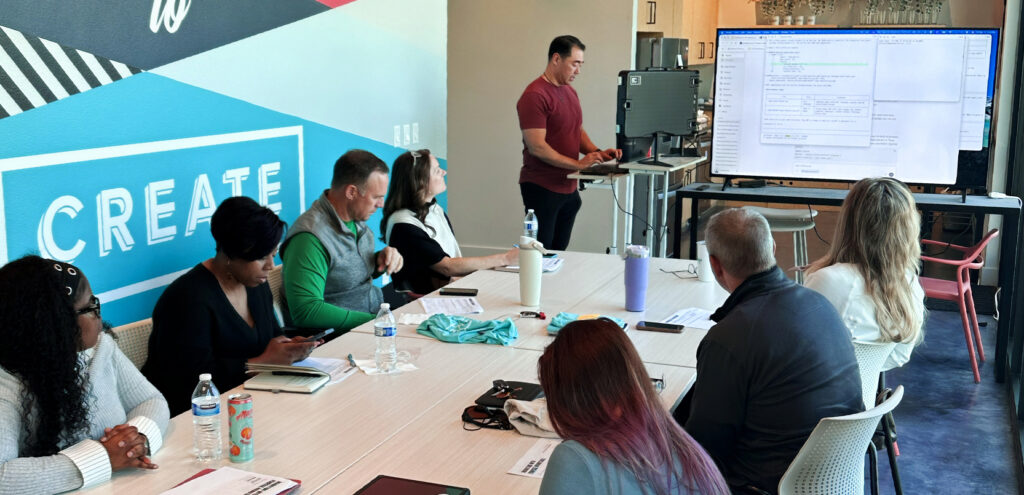
That was the premise of Brew’s August 2026 Marketing Roundtable, where business, sales and marketing leaders gathered at The Brewery to rethink the role of the company website. Tom Martin, Brew’s Business Development Director and author of The Invisible Sale, challenged the familiar idea that a website’s primary job is to attract traffic and collect form fills. A stronger website helps buyers educate themselves, reveals what they care about and gives the sales team better context for the eventual conversation.
The larger point was not that every business needs more technology. It was that a website should be built around the way people actually make decisions. When the content, user experience, sales process and tracking strategy support one another, the site becomes a shared source of intelligence for marketing, sales and leadership.
The first sales call now happens without you
Buyers no longer need to contact a company to begin learning. They may arrive through a referral, a podcast, an email, a paid ad, a Google search or an answer generated by an AI platform. No matter the path, they are usually trying to answer the same questions: Is this company relevant to my problem? Can I trust its expertise? Is its approach meaningfully different? What should I do next?
A website earns the right to continue that conversation by making those answers easy to find and easy to believe. Tom connected this to four signals search engines and buyers both look for: experience, expertise, authoritativeness and trustworthiness. In practice, that means publishing detailed case studies, making subject-matter experts visible through substantive biographies, placing real testimonials near the services they validate, showing awards and third-party recognition, and making basic company and contact information easy to verify.
Technical performance matters, too. Load speed, mobile usability and visual stability shape the experience before a visitor reads a word. But a fast site with vague messaging still fails the buyer. Credibility has to be supported by both the site’s performance and its substance.
Give buyers a useful DIY discovery call
The website does not have to close the entire sale in one visit. It does need to earn the next click. Tom suggested a 90-second test: Can a new visitor quickly understand who the company serves, the problems it solves, why its solution is different or better, and where to go next? If the answer requires digging through generic copy or navigating around the company’s internal structure, the site is making the buyer work too hard.
Good navigation functions as a wayfinder. Labels should reflect how customers think about their needs, not how the organization names its departments. Related content and contextual links should guide visitors toward the next useful answer. This dynamic navigation serves two purposes at once: it reduces friction for the buyer, and every next click adds another clue about the buyer’s interests.
The content itself should be built with the same discipline. Rather than publishing isolated articles, organize related information into interconnected topic areas. Begin with a strong overview page, then link to deeper explanations, comparisons, use cases, FAQs and proof. This creates a more complete learning path for a person while also helping search engines and AI systems understand the depth of the company’s expertise.
A practical place to start is with the questions sales and service teams already hear. Create a shared question bank, rank the questions by frequency and business importance, and turn the strongest answers into website content. Salespeople do not have to become writers to contribute. They can record a voice note after a call or site visit, and the marketing team can use the transcript as raw material for a useful page, article or FAQ.
Structure the site so machines can understand it, too
Content should always be written for people, but it also needs enough structure for search engines and AI systems to interpret it correctly. During the presentation, Tom showed organization, service and FAQ schema: standardized, behind-the-scenes code that identifies a business, describes an offering and pairs common questions with clear answers.
One way to think about schema is as an AI-ready summary attached to each important page. It does not replace strong on-page copy, and it is not a shortcut around real expertise. It clarifies what the page contains so automated systems have a better chance of connecting the business with the right query. The strongest approach is to build for buyers, structure for machines and write with the real concerns and emotions behind the decision in mind.
Move beyond form fills to useful sales intelligence
Many teams still judge a website by traffic and completed forms. Those numbers matter, but they do not automatically tell sales whether a lead is informed, qualified or ready for a productive conversation. A prospect who has returned several times, read a case study, reviewed implementation details and visited a pricing or comparison page may be demonstrating far more intent than someone who completed a form after one quick visit.
The opportunity is to combine signals rather than rely on a single score. Pages viewed, repeat visits, topics consumed, the sequence of those interactions and engagement with high-intent content can create a more useful prospect profile. When appropriate tracking is connected to the CRM, a salesperson can begin with context: what the prospect appears to care about, where they may be in the decision process and which questions are likely to matter next.
This can also reveal patterns beyond one individual buyer. Comparison-page traffic can show which competitors are actually appearing in active evaluations. Content consumption across several people from the same organization can help uncover the buying committee and the different priorities within it. Repeated interest in troubleshooting or onboarding content may expose an operational or customer-experience issue that leadership should address. Website behavior becomes more valuable when it informs business decisions, not just marketing reports.
The roundtable discussion: tools and practical applications
The audience discussion moved quickly from the framework to how it could work inside real organizations. Several participants shared examples of technology being used to capture knowledge, improve sales follow-up and make complex information easier to act on.
Whisper and Gemini for voice-to-text workflows.
The group discussed letting salespeople or field teams record questions, customer conversations or site-visit notes when typing is impractical. A workflow can send the audio to a transcription model such as Whisper or Gemini, save the text in Google Drive or a CRM and create a summary. With appropriate consent and privacy safeguards, those recordings can preserve valuable customer language and give marketing better source material for FAQs, service pages and follow-up content.
Airtable for a scalable question and content database.
A spreadsheet is an easy way to pilot a shared question bank, but it can become fragile as more people, automations and content
fields are added. Airtable was discussed as a database that still feels familiar to spreadsheet users while offering a more durable structure for storing transcripts, questions, content status and related assets.
Google Analytics and CRM tracking for intent signals.
Participants talked about monitoring referral traffic from AI platforms and connecting website behavior to known contacts when the technology and privacy settings allow it. The goal is not to treat every click as certainty. It is to use several imperfect signals together to prioritize follow-up and learn which content paths tend to precede stronger conversations.
Trackable web links instead of static PDFs.
For complex or high-value sales, sending a web-based capabilities page or proposal resource can reveal which topics people revisit and which members of a buying committee are engaging. A static PDF may be easy to send, but it usually provides little insight after it leaves the salesperson’s inbox. A trackable link creates a better feedback loop between sales activity and buyer behavior.
Claude Skills, APIs and Power Query for repeatable reporting.
One attendee described using a repeatable Claude Skill with data from a CRM, GPS platform and industry software, while Power Query and API connections helped consolidate the information into daily sales reports and KPI views. The example showed how AI can support a defined reporting process, but also why teams should understand data quality, integration costs and the limitations of a pilot before scaling it.
AI-assisted discovery tools and clickable prototypes.
Brew’s creative team demonstrated an interactive discovery experience built for a complex website project. Instead of asking busy division leaders to review a 100-plus-page copy document, the team walked through each page section visually, asked focused questions and used a progress indicator to complete the discussion in about 40 minutes. The team also showed a clickable AI-assisted proof of concept that helped a highly visual client understand the proposed direction before formal design began. It was presented transparently as an advanced mood board, not a production-ready website or a replacement for strategy and creative development.
The specificity of these examples mattered. The discussion was not about adopting every available platform. It was about choosing a real business problem, testing the smallest useful workflow and keeping people responsible for judgment, accuracy, privacy and the final customer experience.
A practical website starting point
Run the 90-second test
Ask someone outside the company to review the homepage without guidance. Can they identify the audience, problem, difference, proof and next step? Note where they hesitate.
Build the question bank
Ask sales, customer service and technical teams to contribute the questions they hear most. Rank them, identify which answers are missing or weak online, and assign the first five for development.
Put proof where the claim appears
Review important service pages for case studies, named experts, authentic testimonials, client examples, awards and other third-party validation. Do not hide all credibility on one testimonials page.
Create a connected content path
Choose one high-priority topic and map an overview page, deeper answers, an example or case study, a comparison resource and a clear next step. Link them in the order a buyer would naturally need them.
Replace one opaque sales asset
Convert one frequently used PDF into a useful, trackable web resource. Decide in advance what engagement would indicate real interest and how sales should respond.
Define the intelligence the team actually needs
Before adding tools, agree on the decisions the data should improve. That may include lead prioritization, sales follow-up, content planning, competitive positioning or identifying friction in onboarding and service.
A website should become more valuable over time
The roundtable closed with a useful reframing: a website should be treated less like a short-term marketing expense and more like a long-term business asset. Its value compounds as the company adds better answers, clearer proof, stronger navigation and more useful behavioral insight.
That does not mean adding technology for technology’s sake or reducing people to data points. It means aligning the site with the questions buyers are asking, the information sales needs and the patterns leadership should see. The companies with the strongest advantage may not be the ones that spend the most. They may be the ones that understand their buyers best and make that understanding useful across the organization.
Have questions about Brew’s Marketing With Purpose Roundtables or want to know about future events? Contact agency@think-brew.com.
Related links
Marketing With Purpose Roundtable Recap: Session 1